
Love.
It is the longing at the centre of so many lives.
The pulse that draws us toward one another, even when our heads warn us to keep a safe distance.
It’s the reason we stay awake at night replaying a conversation, the reason we write letters we never send, the reason a song can catch us off guard and leave us standing still in the middle of a crowded street.
It is also the feeling that makes our hands tremble.
Because alongside the beauty of love lives its shadow — the fear that it will hurt, that it will change us, that we will lose ourselves in it, or that it will never arrive at all.
When I began listening, really listening, to people talk about their relationships — clients, friends, strangers who confided — I heard the same undercurrent in their stories.
It was never just about the relationship itself.
It was about the quiet weight they carried inside it.
The worry that they were not enough, or that they were too much.
The unease of showing their real selves and wondering if those selves would be accepted.
The dread of making the same mistakes they had promised themselves they would never repeat.
Some feared that love would mean losing the independence they had fought hard to protect. Others feared betrayal, the breaking of trust so profound it would change them forever.
For some, it was the ache of abandonment, the kind that rewires you to always keep one foot out the door. And for many, the most difficult fear was not of love ending, but of what love might ask of them if it stayed.

Love changes over time.
Even the strongest relationships are not immune to its shifts.
I’ve seen people afraid of those changes, clinging to the early days as if that’s the only proof the love was real.
I’ve seen others hold back because they feared being judged — judged for how they love, who they love, or for wanting something different than what the world tells them is “right.”
And there is the fear, perhaps the quietest but most potent of all, of ending something and stepping into the unknown beyond it.
These fears rarely announce themselves in full sentences.
They show up in smaller ways — hesitation before returning a call, a sharpness in the tone of voice when you feel cornered, the excuses you make to avoid conversations that matter.
Sometimes they appear as patterns, looping through years and relationships like an old song you can’t stop humming.
I have watched people bend themselves into shapes they no longer recognize just to keep a relationship from falling apart.
I have seen them walk away too soon, convinced they are saving themselves, only to carry the same fears into the next chapter.
I have also seen the bravery of those who stayed, not out of habit or fear, but because they chose to — eyes open, heart open — knowing the work that would come with it.
Fear, when left unexamined, makes us defensive.
It narrows our vision until all we can see are the exits. But when we look at it directly, without flinching, it becomes something else — a map of where we’ve been and what matters most to us.
Love does not belong to one stage of life.
You might be feeling love’s pull for the first time, questioning long-standing patterns, rediscovering connection after years on your own, or opening yourself to companionship again after loss.
My work with people over the years has taught me that fear in love is not a sign of weakness. It’s a sign of caring — sometimes too much, sometimes in ways that exhaust us. The real danger is not feeling fear, but letting it quietly dictate the kind of love we allow ourselves to have.
This is not about erasing fear.
Instead, this is about looking at the places where fear lives.
Not to conquer it, not to shame it, but to understand it.
Because once you understand your fear, it becomes harder for it to disguise itself as logic, harder for it to quietly sabotage the very connection you long for.
Fear can look like an unscalable wall, but more often it is a door disguised as one. The handle is always on our side, even if it takes time, courage, and a steady hand to turn it.
If you’ve ever felt love hovering close yet found yourself stepping back, if you’ve stayed longer than you knew was wise, if you’ve left wondering whether you should have stayed — this book is for you.
It will not tell you what love should look like.
It will not pretend that love is easy.
But it will walk with you into the truth of it: that the most beautiful love stories are not the ones without fear, but the ones in which fear has been met, understood, and gently set down.
Because the point is to show you that fear does not get to be the author of your love story — you do.
And in the end, the love you live is shaped not by the fear you feel, but by how you choose to meet it.
— Excerpt from Fear OFF Love, a part of the “Fear OFF’ series
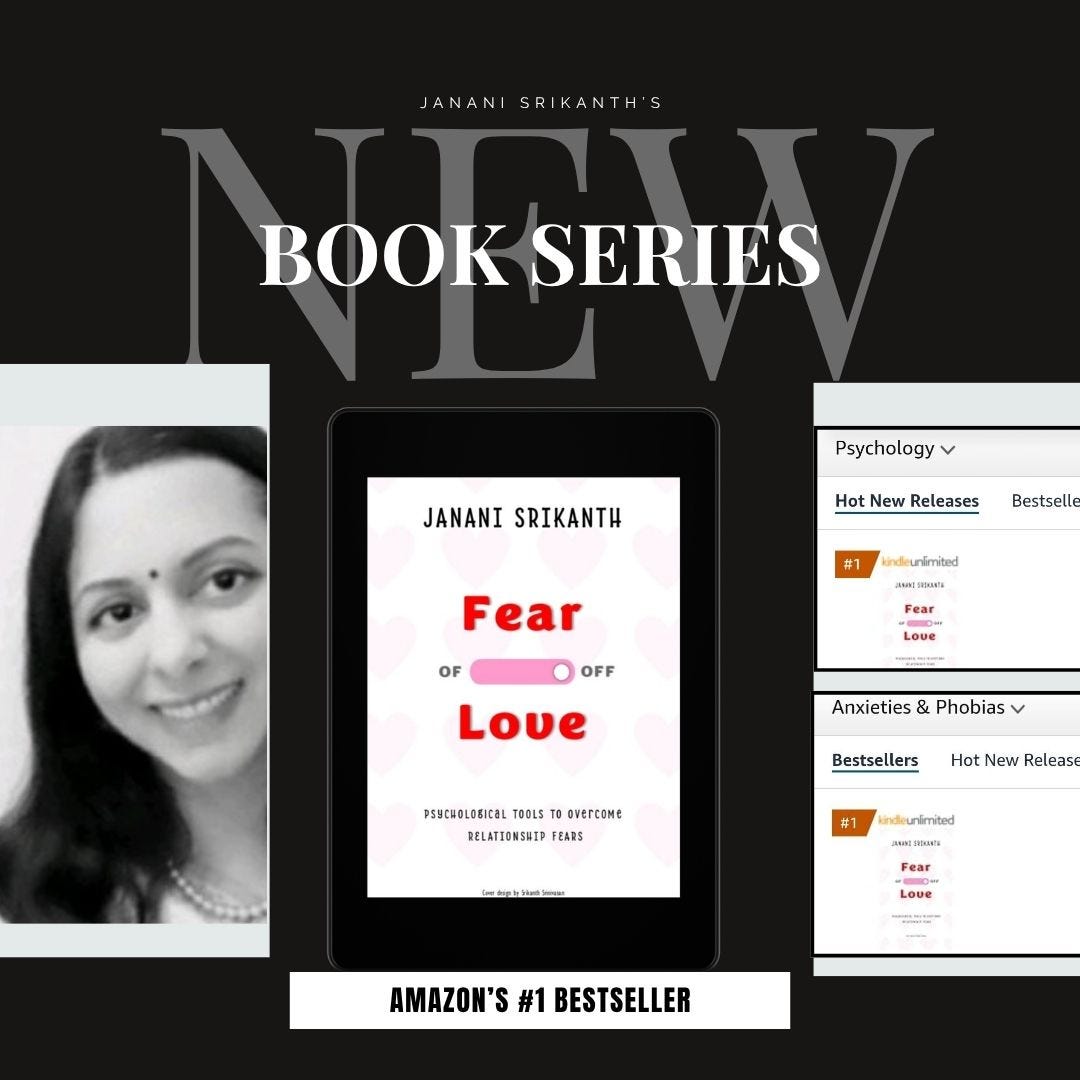
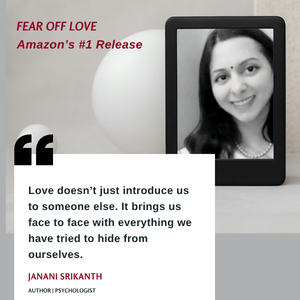
Fear OFF Love, the latest by Janani Srikanth is trending as Amazon’s #1 Hot New Release in the Psychology and Anxiety & Phobias category. You can find the book here: https://www.amazon.in/Fear-OFF-Love-Psychological-relationship-ebook/dp/B0GT24QSHD
No comments:
Post a Comment