Friday, March 27, 2026

Fear OFF Love


Love.

It is the longing at the centre of so many lives.

The pulse that draws us toward one another, even when our heads warn us to keep a safe distance.

It’s the reason we stay awake at night replaying a conversation, the reason we write letters we never send, the reason a song can catch us off guard and leave us standing still in the middle of a crowded street.

It is also the feeling that makes our hands tremble.

Because alongside the beauty of love lives its shadow — the fear that it will hurt, that it will change us, that we will lose ourselves in it, or that it will never arrive at all.

When I began listening, really listening, to people talk about their relationships — clients, friends, strangers who confided — I heard the same undercurrent in their stories.

It was never just about the relationship itself.

It was about the quiet weight they carried inside it.

The worry that they were not enough, or that they were too much.

The unease of showing their real selves and wondering if those selves would be accepted.

The dread of making the same mistakes they had promised themselves they would never repeat.

Some feared that love would mean losing the independence they had fought hard to protect. Others feared betrayal, the breaking of trust so profound it would change them forever.

For some, it was the ache of abandonment, the kind that rewires you to always keep one foot out the door. And for many, the most difficult fear was not of love ending, but of what love might ask of them if it stayed.


Love changes over time.

Even the strongest relationships are not immune to its shifts.

I’ve seen people afraid of those changes, clinging to the early days as if that’s the only proof the love was real.

I’ve seen others hold back because they feared being judged — judged for how they love, who they love, or for wanting something different than what the world tells them is “right.”

And there is the fear, perhaps the quietest but most potent of all, of ending something and stepping into the unknown beyond it.

These fears rarely announce themselves in full sentences.

They show up in smaller ways — hesitation before returning a call, a sharpness in the tone of voice when you feel cornered, the excuses you make to avoid conversations that matter.

Sometimes they appear as patterns, looping through years and relationships like an old song you can’t stop humming.

I have watched people bend themselves into shapes they no longer recognize just to keep a relationship from falling apart.

I have seen them walk away too soon, convinced they are saving themselves, only to carry the same fears into the next chapter.

I have also seen the bravery of those who stayed, not out of habit or fear, but because they chose to — eyes open, heart open — knowing the work that would come with it.

Fear, when left unexamined, makes us defensive.

It narrows our vision until all we can see are the exits. But when we look at it directly, without flinching, it becomes something else — a map of where we’ve been and what matters most to us.
Love does not belong to one stage of life.

You might be feeling love’s pull for the first time, questioning long-standing patterns, rediscovering connection after years on your own, or opening yourself to companionship again after loss.

My work with people over the years has taught me that fear in love is not a sign of weakness. It’s a sign of caring — sometimes too much, sometimes in ways that exhaust us. The real danger is not feeling fear, but letting it quietly dictate the kind of love we allow ourselves to have.

This is not about erasing fear.

Instead, this is about looking at the places where fear lives.

Not to conquer it, not to shame it, but to understand it.

Because once you understand your fear, it becomes harder for it to disguise itself as logic, harder for it to quietly sabotage the very connection you long for.

Fear can look like an unscalable wall, but more often it is a door disguised as one. The handle is always on our side, even if it takes time, courage, and a steady hand to turn it.

If you’ve ever felt love hovering close yet found yourself stepping back, if you’ve stayed longer than you knew was wise, if you’ve left wondering whether you should have stayed — this book is for you.

It will not tell you what love should look like.

It will not pretend that love is easy.

But it will walk with you into the truth of it: that the most beautiful love stories are not the ones without fear, but the ones in which fear has been met, understood, and gently set down.

Because the point is to show you that fear does not get to be the author of your love story — you do.

And in the end, the love you live is shaped not by the fear you feel, but by how you choose to meet it.

Excerpt from Fear OFF Love, a part of the “Fear OFF’ series
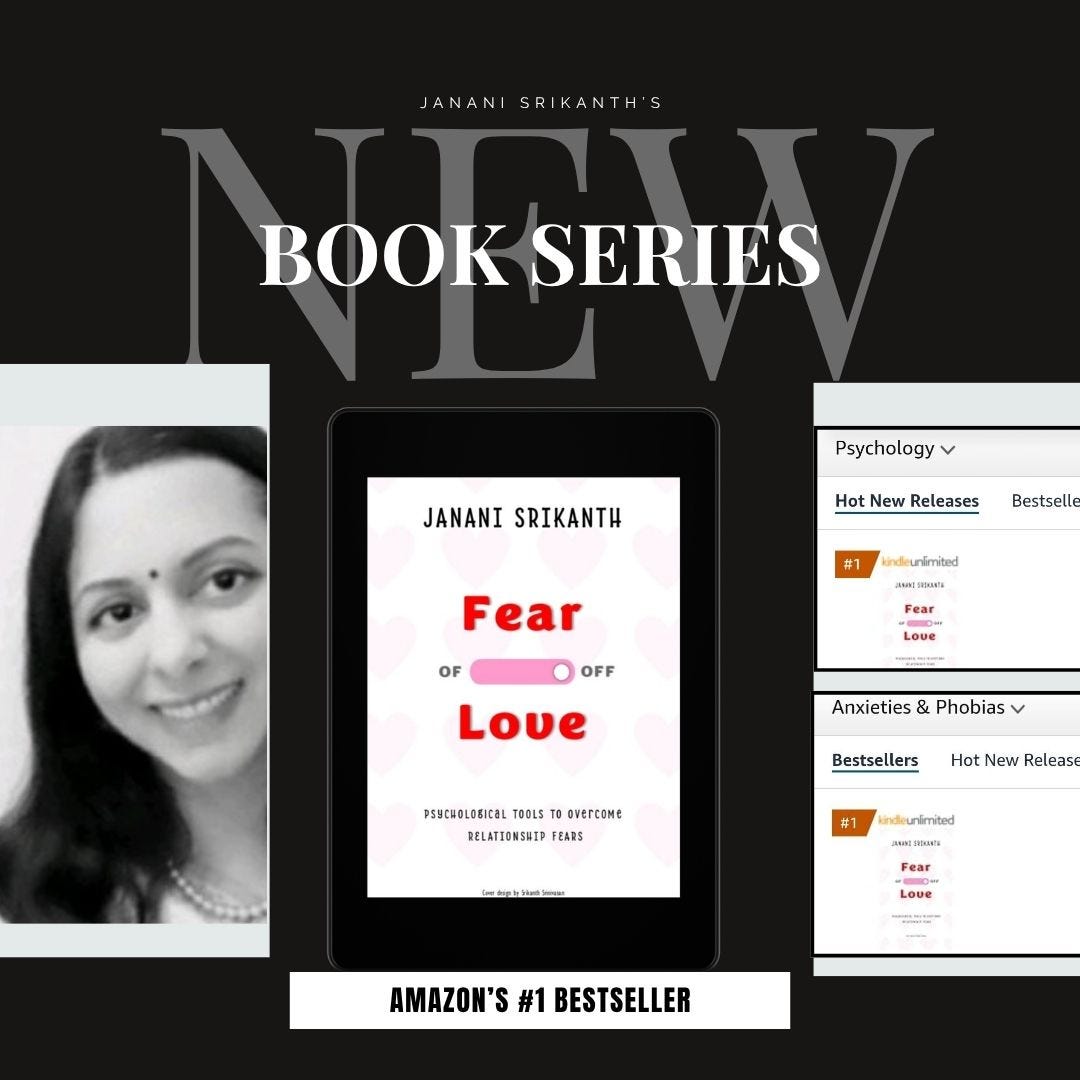


Fear OFF Love, the latest by Janani Srikanth is trending as Amazon’s #1 Hot New Release in the Psychology and Anxiety & Phobias category. You can find the book here: https://www.amazon.in/Fear-OFF-Love-Psychological-relationship-ebook/dp/B0GT24QSHD


Saturday, March 7, 2026

The Quiet Truth About Empowering Women


How can I empower other women?


Someone I know asked this question to a group recently. I happened to observe the conversation from a distance and found myself quietly wondering about the question itself.


Can anyone really decide to empower another person?


Success is often presented as the qualification. You are doing well, you earn well, you have visibility.


But is that what empowerment means? And how is it different from influence or inspiration?


Sometimes the question almost sounds like a subtle way of saying I have arrived and now I will lift others.


Personally, I see it differently.


I believe our first responsibility is to live our own life with sincerity.


To understand our circumstances. To make the best choices we can, aligned with our values, our growth, and our sense of progress.


When we do that with honesty, something quiet begins to happen.


People notice. Not because we declared ourselves an example, but because our life reflects a certain steadiness.


In that moment, we may become someone else’s inspiration. And sometimes that inspiration may lead to empowerment or change in their life.


But that role is not something we appoint ourselves to.


Empowerment is not a title we take on like teacher or manager. It is something another person feels in your presence. It is an honour they give you because your life, your decisions, or your courage spoke to them at the right moment.


Women do not need to wait for someone else to empower them.


Every woman already carries the capacity to find her voice, her direction, and her strength within herself and within her community.


We are relevant. We are important. Our lives carry meaning.


Not only the grand stories of visible success.


The quiet ones too.


The grandmother who held the family together.


The sister who showed dignity in difficult times.


The mother who kept moving forward when life demanded strength.


These stories shape us as much as any public figure.


Inspiration often lives in the ordinary moments of life.


So perhaps the question is not how to empower others.


Perhaps the real work is simpler.


Live your path with clarity. Listen to your inner voice. Move forward with grace and courage.


You never really know who might be watching your small, sincere steps and finding the strength to take their own.


And if there is a woman you have quietly admired from a distance, someone whose choices or courage inspired you, tell her today.


Women acknowledging and uplifting other women is something worth making a trend.


Happy Women’s Day.


#WomensDay #Empowerment

Acts of Love

This month, I’ve been writing under the theme #LoveAndFear.

The reflections explored a pattern many thoughtful people quietly encounter in their relationships.

The first looked at the intelligent mind navigating confusing dynamics. Many people notice patterns quickly. They register inconsistencies, emotional shifts, and the subtle ways distance begins to form. Awareness is rarely absent. In fact, many people understand the dynamics of their relationships with surprising clarity.

The second reflection explored compatibility. Shared ideas and intellectual alignment often appear promising at the beginning of a relationship. Yet agreement alone does not guarantee ease. Two people may think alike and still struggle to feel settled together. What ultimately shapes connection is not only shared perspective, but the emotional environment two people create with each other.

Taken together, these reflections reveal something quietly important.

Understanding relationships and participating in them are not the same experience.

The mind is skilled at observation. It notices patterns, interprets behaviour, and searches for explanations that make sense of what is unfolding. This ability brings valuable insight. It can help us understand why certain dynamics repeat and why particular moments feel charged or fragile.

But relationships do not move forward through understanding alone.

At some point, clarity asks something more personal.

It asks whether we are willing to stand beside what we see.

Participation in love is rarely comfortable at the beginning. To say what matters to you invites the possibility of disagreement. To acknowledge emotional needs creates vulnerability. Even expressing care openly carries risk, because it reveals the depth of what you hope for in return.

Yet connection rarely deepens where everything remains carefully interpreted but never expressed.

Relationships grow when someone is willing to move from observation into presence. When curiosity replaces quiet calculation. When honesty is allowed to exist even without the reassurance of certainty.

Courage in love is rarely dramatic. It appears in smaller moments. In the willingness to ask a difficult question. In the choice to speak a feeling rather than suppress it. In the quiet decision to remain emotionally available even when outcomes cannot be predicted.

Awareness may illuminate the landscape of a relationship.

But it is courage that allows two people to walk through it together.

Let’s take the fear OFF love.

Fear OFF Love | Releasing 19.03.26

#LoveAndFear #FearOFFLove #RelationshipPsychology #FearOFF #Anxiety


The curious case of elusive compatibility.


You know your ideology.
You read.
You think.
You can hold your ground in any discussion.
You know what you believe about life, work, politics, and purpose.
You can articulate your worldview clearly and defend it thoughtfully.

Yet many intelligent people still encounter a quiet paradox in their personal lives.

If clarity of thought matters so much, why is compatibility in relationships so rare?

The answer is simple, though not always comfortable.

Compatibility is not built only on intelligence. It is built on emotional alignment.

Relationships do not unfold only in the realm of ideas. They move through emotional habits, attachment patterns, fears, and expectations formed long before either person met.

Shared opinions do not guarantee ease.

Two people may agree on politics, books, and social issues and still feel strangely distant. At the same time, two people with different views can feel deeply settled in each other’s presence.

What determines connection is rarely alignment of thought. It is emotional safety.

You may have strong views. Someone else may not mirror that intensity. That does not mean they lack depth.

Not everyone signals intelligence through argument.

Some signal it through restraint. Through listening. Through choosing not to turn early conversations into battlegrounds.

Disagreement is not the same as deficiency.

When identity becomes tightly wrapped around opinions, posture subtly shifts. The tone becomes firm. Not hostile. Simply certain. But certainty can sometimes feel like evaluation to the other person for the other person. Most people do not expand where they feel assessed.

There is also an important difference between intellectual openness and emotional openness.

It is easy to discuss systems, policies, and global events. 

It is harder to say “this unsettles me, this is where I feel unsure, this is what I need.”

Compatibility often lives in that softer territory.

The clearer you are in your views, the more space you must create for someone who expresses themselves differently. Otherwise strong identity meets quiet withdrawal.

Love is rarely won through precision of argument. It grows where curiosity is mutual and disagreement does not threaten belonging.

Let’s take the fear OFF love.

Fear OFF Love | Releasing 19.03.26

#LoveAndFear #FearOFFLove #RelationshipPsychology #FearOFF #Anxiety


The intelligent mind in confusing relationships.

Intelligence brings steadiness.


It builds self-trust. It creates a quiet confidence in perception. It registers patterns in interactions.


There is very little that escapes awareness and it creates a natural rhythm in the way you think, process and approach life.


That confidence feels reliable, almost instinctive. Until emotion enters and the rhythm shifts.


Emotion does not blur perception. It alters attachment to outcome.


The inconsistencies are still seen. The red flags are still felt. The tension between what you see and what you tolerate is still alive.


What shifts is internal. A quiet hesitation enters where action once felt instinctive.


In structured environments, intelligence operates without emotional stake. Decisions are made based on coherence. Misalignment is corrected. Boundaries are adjusted. The cost of acting is limited.


In relationships, the cost is not abstract. It is relational. It is emotional. It is the imagined future you have already begun to hold.


Attachment changes the meaning of clarity.


When care deepens, perception becomes heavier. Acting on what is seen may mean confrontation. It may mean loss. It may mean acknowledging that the version of the person you hoped for is not the one consistently present.


So intelligence begins to work differently. It expands context. It accounts for history and emotional vulnerability. It searches for narrative continuity. It prefers explanation over rupture.


There is maturity in that instinct. It resists impulsivity. It allows complexity.

But there is also avoidance hidden inside it.


A high analytical mind can explore another person’s psychology with precision. It can dissect behaviour, identify defence mechanisms, anticipate emotional cycles.


That analysis feels contained. Safe.


What feels riskier is exposing one’s own position.

To say, this pattern affects me.

To admit, I need steadiness.

To acknowledge, this inconsistency makes me withdraw.


Self-revelation carries vulnerability. It removes the protective distance that analysis provides.


This is where intelligent people often remain suspended — not between knowing and not knowing, but between seeing and declaring.


The confusion in such relationships is rarely cognitive. It is relational.


When perception is separated from self-disclosure, ambiguity persists. When they align, clarity follows — not because the other person changes, but because internal contradiction dissolves.


Intelligence sharpens vision.

Love tests whether that vision will be lived without armour.


Let’s take the fear OFF love.

Fear OFF Love | Releasing 19.03.26


#LoveAndFear #FearOFFLove #RelationshipPsychology #FearOFF #Anxiety